
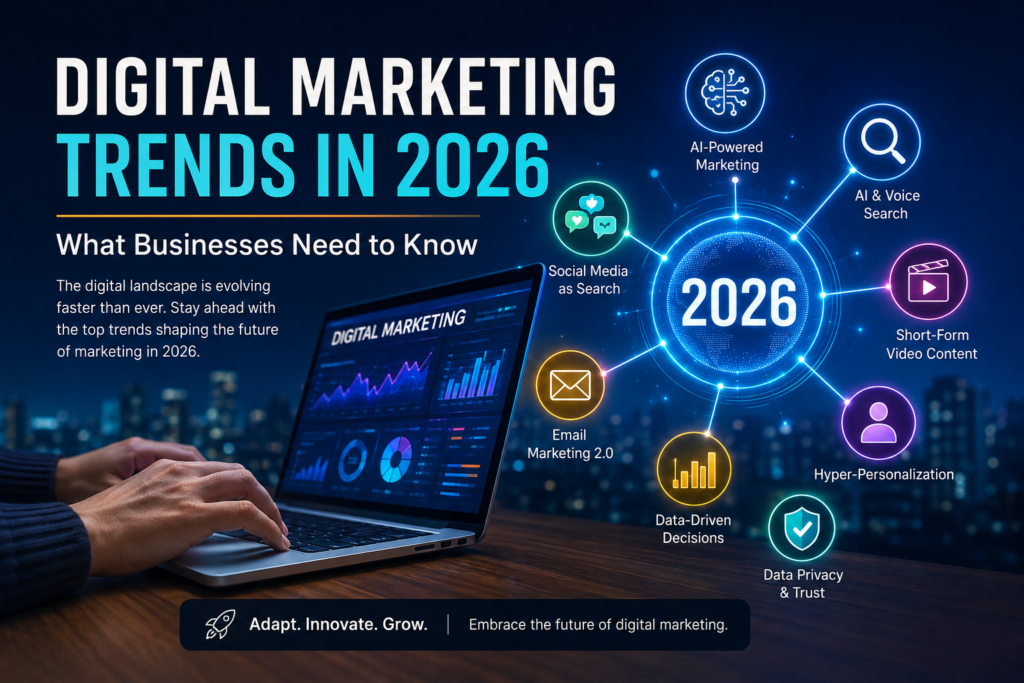
Digital marketing continues to change rapidly, and 2026 is proving to be a major year for businesses, marketers, and consumers. Artificial intelligence, changing search behavior, short-form video, personalization, and data-driven marketing are transforming how brands attract and engage customers.
For businesses, simply having a website or posting regularly on social media is no longer enough. Customers expect useful content, fast answers, personalized experiences, and genuine communication. At the same time, search engines are increasingly using AI to answer questions directly instead of simply displaying a list of links.
Here are the most important digital marketing trends businesses should understand in 2026.
1. AI Is Becoming a Core Marketing Tool
Artificial intelligence is no longer just an experimental technology. Businesses are using AI to support content creation, customer service, data analysis, advertising, research, and personalization.
AI can help marketers generate ideas, analyze customer behavior, identify trends, create content variations, and automate repetitive tasks. However, businesses should not depend on AI to produce everything automatically.
The strongest strategy is combining AI efficiency with human creativity, experience, and judgment. Consumers still value authentic stories, original opinions, and content that genuinely understands their problems.
2. Search Is Moving Beyond Traditional SEO
Search behavior is changing significantly in 2026. People are increasingly using AI-powered search experiences to ask detailed questions and receive summarized answers.
Google has expanded AI features such as AI Overviews and AI Mode, while its Search Console has introduced generative-AI performance reporting for some websites. These reports can show visibility within AI-generated search experiences.
This means businesses should think beyond traditional keyword rankings. SEO remains important, but marketers also need to create content that clearly answers real customer questions and provides original value.
Google’s own guidance emphasizes that traditional SEO fundamentals remain relevant for AI search. Websites still need technically accessible pages and helpful, reliable, people-first content.
3. GEO and AEO Are Getting More Attention
Generative Engine Optimization (GEO) and Answer Engine Optimization (AEO) have become important discussions among marketers.
The goal is not simply to rank for a keyword. Businesses increasingly want their information to be understood and potentially referenced by AI-powered search experiences.
For example, instead of creating an article only around the keyword “best digital marketing agency,” a business could create comprehensive content answering questions such as:
- What does a digital marketing agency do?
- How much does digital marketing cost?
- Which marketing strategy is best for small businesses?
- How can a local business generate more leads online?
This approach creates useful content for people while also making the information easier for search systems to understand.
4. Short-Form Video Remains Powerful
Short-form video continues to be one of the most effective ways to capture attention online.
Platforms built around short videos have changed how people discover brands, products, services, and creators. Businesses can use short-form videos to explain products, answer common questions, share behind-the-scenes content, demonstrate expertise, and tell customer stories.
The key is not simply producing more videos. Businesses should focus on creating videos that provide value quickly.
A strong 30–60 second video can answer one specific question, solve one problem, or communicate one useful idea.
5. Social Media Is Becoming a Search Channel
People increasingly use social platforms to discover information, businesses, products, restaurants, creators, and recommendations.
This makes social SEO increasingly important. Businesses should use clear captions, relevant keywords, descriptive profiles, useful video titles, and content that directly answers audience questions.
Instead of treating social media only as a place to publish promotional posts, businesses should treat it as a discovery platform.
For example, a local restaurant could create content around searches such as “best breakfast in Kochi,” while a digital marketer could create content around “digital marketing tips for small businesses.”
6. Personalization Is Becoming More Important
Customers do not want to feel like they are receiving the same generic message as everyone else.
Personalization allows businesses to deliver more relevant content, offers, emails, and recommendations based on customer interests and behavior.
AI is making personalization easier by helping businesses analyze large amounts of customer data and identify patterns.
However, personalization should be useful rather than intrusive. Businesses need to respect privacy and use customer information responsibly.
7. Authentic Content Is More Valuable
As AI-generated content becomes easier to produce, generic content is becoming increasingly common.
This creates an opportunity for businesses that can demonstrate real expertise and originality.
Instead of publishing dozens of basic AI-generated articles, brands should focus on original research, real experiences, case studies, expert opinions, customer stories, and practical examples.
This is particularly important because platforms are increasingly concerned about low-quality and repetitive AI-generated content. The marketing advantage in 2026 is not simply producing more content—it is producing content worth remembering.
8. Data and Measurement Matter More Than Ever
Digital marketing decisions should be based on data rather than assumptions.
Businesses need to understand which channels generate traffic, leads, sales, and customer engagement. Important metrics can include conversion rate, customer acquisition cost, return on advertising spend, engagement, organic visibility, and customer lifetime value.
Google’s new generative-AI Search Console reporting is another example of how search measurement is evolving alongside AI search.
Marketers should therefore monitor both traditional performance and emerging AI-search visibility.
9. Trust and Brand Reputation Are Critical
AI-powered search can influence how customers perceive a business. Information about a company can come from websites, reviews, social media, and other online sources.
This makes online reputation increasingly important.
Businesses should maintain accurate information across their digital channels, encourage genuine customer feedback, respond professionally to reviews, and regularly check how their brand is represented online.
Being visible is valuable, but being accurately represented is even more important.
10. Human Connection Still Wins
Despite all the technological changes, marketing is still about people.
AI can automate tasks and analyze information, but businesses need human creativity, empathy, storytelling, and communication to build lasting relationships.
The most successful brands in 2026 will likely be those that use technology without losing their human identity.
Conclusion
Digital marketing in 2026 is not about replacing traditional marketing with AI. It is about adapting to a changing digital environment.
AI-powered search, GEO, AEO, short-form video, social search, personalization, authentic content, and advanced analytics are changing how businesses reach customers.
However, the fundamentals remain the same: understand your audience, solve real problems, create valuable content, build trust, and measure your results.
Businesses that combine new technology with strong marketing fundamentals will be better positioned to compete in the evolving digital landscape.
The future of digital marketing is not simply AI versus humans. It is AI helping humans create smarter, more useful, and more meaningful marketing experiences.